 N環球

JPMorgan Revises Note: Nvidia Holds Just 28% of Frontier Labs' Future Compute Deals as Custom Chips Take 53%
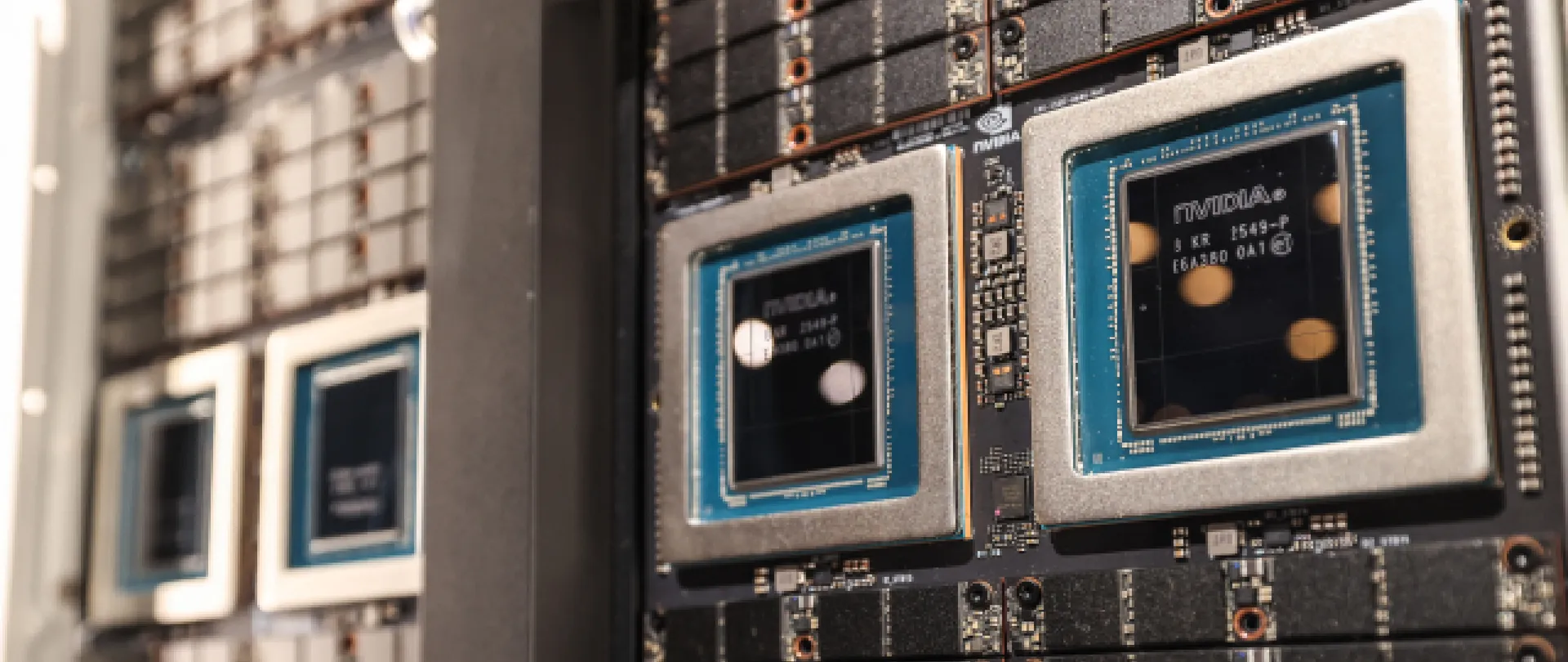
JPMorgan Asset Management revised its Eye on the Market note, cutting Nvidia's share of frontier AI labs' future compute agreements from 39% to 28%; custom chips from Broadcom, Google and Amazon now total 53%.
JPMorgan Asset Management strategist Michael Cembalest revised his Eye on the Market report, The Icarus Files, on November 16, cutting Nvidia's share of frontier AI labs' future compute agreements from 39% to 28% — about 12.1 gigawatts out of a total of roughly 44 GW. Custom chips from Broadcom, Google and Amazon together account for 53%. The revised edition also names Anthropic, saying its Claude Mythos model cut the time to move models onto AMD chips to about three days, a sign that the switching-cost advantage of Nvidia's CUDA software ecosystem is narrowing.
The numbers: custom chips at 53%
The revised chart measures “frontier lab future compute agreements” in gigawatts. Nvidia accounts for 28% (about 12.1 GW), Broadcom custom chips 23% (about 10 GW), AMD GPUs 18% (about 8 GW), Amazon Trainium 16% (about 7 GW), Google TPUs 14% (about 6 GW) and Cerebras 2% (about 0.75 GW). Broadcom, Google and Amazon custom chips together reach 53%, 25 points more than Nvidia.
The note also says Nvidia “earned 83% of AI chip revenues from 2023-2025 with gross margins of 75% and operating margins of 66%”. In Cembalest's reading, the key shift is not toward AMD but toward custom silicon: labs are increasingly adopting chips tailored to their own models.
Switching costs fall as Anthropic moves to AMD in three days
The revised note names Anthropic: its Claude Mythos model almost single-handedly wrote the low-level compute kernels needed to run Anthropic's models on AMD MI355X accelerators, completing the move in about three days, compared with six to 12 months a year ago. Citing an Epoch AI inference index, the note says AMD's MI455X scores about 2.9 times Nvidia's GB300 on modelled performance per chip, and even beats Nvidia's own Vera Rubin VR200, at about 2.2 times. Nvidia's Rubin Ultra series, due in 2027, “may change that”.
From 1% to 8.5% of the S&P 500 — and back down
The report traces Nvidia's rapid rise and fall: from about 1% of the S&P 500 in December 2022 to 8.5% in May 2026, the fastest ascent to the top of the index on record, then back below 6% over the past six weeks, with the stock down about 32% from its all-time high. Cembalest still writes that Nvidia “looks interesting for long term holders”, with a price-to-earnings-to-growth ratio of just 0.2 times, the lowest valuation among large AI stocks.
Earnings and the CEO search: the latest
The note landed after Jensen Huang resigned as Nvidia's chief executive on November 12. Nvidia reported third-quarter revenue of $115.8 billion on November 17, beating expectations (reported separately on this site); the board has ruled out a return by Huang, and the search for a permanent chief executive continues. The South Korean government said Nvidia's commitment to supply 260,000 GPUs to South Korea remains fully intact.
Caveats behind the figures
The Cembalest note is the author's own view; its disclaimer says it “in no way constitutes J.P. Morgan Research”. The note does not list the agreements behind the 28% or give the dates those agreements run to. The figures describe the distribution of future compute agreements, not current shipments or revenue.
(Update: this article first appeared on November 15 citing the original edition of the note, which put Nvidia's share at 39% and custom chips at 46%; it has been updated to the revised figures issued by JPMorgan on November 16.)
💬 Comments
No comments yet. Be the first!